
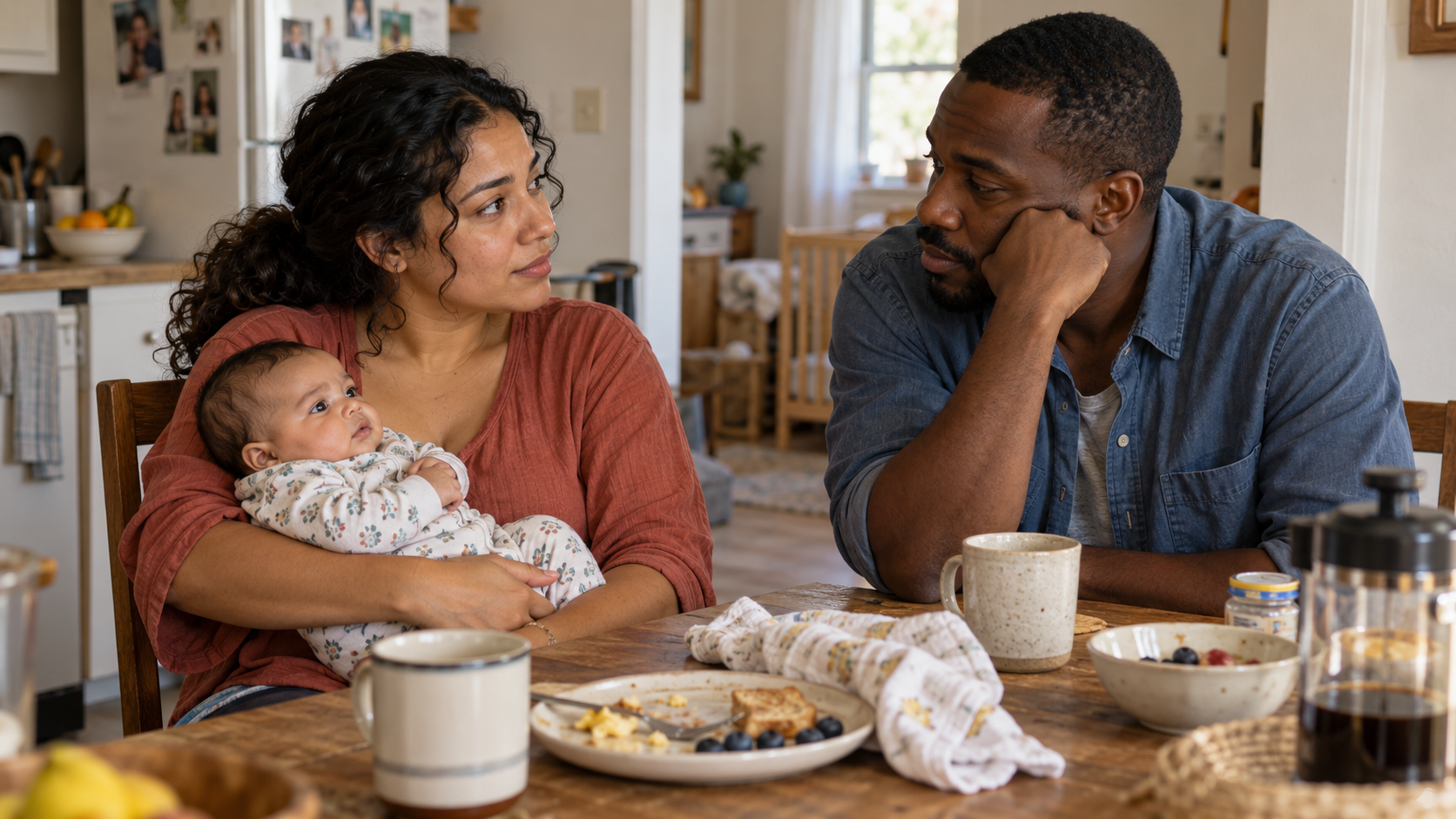
There is a particular kind of madness that belongs to the first few weeks with a baby.
Perfectly capable adults begin losing things while holding them. Someone puts something somewhere completely inexplicable. Nobody can remember which breast the baby fed from, despite having had an apparently serious conversation about it twenty minutes earlier.
You can find yourself standing over a sleeping newborn debating whether the tiny noise they just made is completely normal or evidence that somebody should call a paediatrician immediately.
Sometimes, when everybody is exhausted and the baby is finally asleep, the only sensible thing left to do is laugh.
I use humour a lot in my work.
Not because any of this isn’t serious.
Precisely because sometimes it feels so serious.
Before this baby arrived, you probably knew how to be a person in the world. You had spent years becoming competent.
Perhaps you had a career you were exceptionally good at. People came to you for answers. You made decisions every day without wondering whether each one might somehow damage somebody you loved.
And then somebody handed you a tiny human being.
Suddenly, I don’t know entered your life in a completely different way.
You don’t know why they’re crying. You don’t know whether they’ve had enough. Something that worked beautifully yesterday has apparently been rejected by management today.
And underneath so many of those questions is another one:
Am I doing a good job?
I think this is an extraordinary thing for a human being to go through.
And both of you are going through it.
You don’t become parents in exactly the same way
A baby may belong equally to two people, but that doesn’t mean the experience of becoming that baby’s parents feels equal from the beginning.
For many mothers, by the time the baby arrives, becoming a parent has already been happening through the body for months.
We carried the baby. We felt them move. We gave birth. Some of us breastfeed. Our bodies are recovering while simultaneously being asked to sustain and respond to this completely dependent little person.
Research increasingly shows that pregnancy and the postpartum period involve significant changes in the maternal brain, including systems involved in attention and responsiveness to a baby. But biology isn’t the whole story. Caregiving experience matters too, and research in fathers has also found changes associated with becoming and actively being a parent.
I see something of this difference in families all the time.
A mother desperately wants her partner to take the baby so she can sleep.
He takes the baby.
She lies in bed listening.
She knows he is perfectly capable of responding. She knows she needs sleep. She may even be furious that she is the one who has been awake for most of the night.
And then the baby cries and every part of her wants to get up.
I don’t think we talk about that contradiction enough.
We can want the responsibility to be shared and still find it incredibly difficult to relinquish it.
Sometimes a mother wants somebody else to settle the baby while fighting the urge to tell them exactly how to do it. She can resent being the person who seems to know what the baby needs while simultaneously feeling an enormous need to be the person who knows.
That doesn’t make her controlling.
And it doesn’t make her partner incapable.
They are simply learning to parent from different starting points.
He is new at this too
This matters to me because I don’t recognise the story of early parenthood as simply an exhausted mother and a useless father.
I have seen frightened fathers.
I have watched men who are extraordinarily accomplished in the rest of their lives hold a tiny baby with an expression that says quite clearly, Please don’t let me break this.
And I have watched them learn.
There is something beautiful that happens when a father is given enough space to discover his own relationship with his baby.
He doesn’t necessarily have to settle the baby exactly the way Mum does. His arms feel different. His voice is different. He smells different. Eventually he may discover something that works beautifully for the two of them and has absolutely nothing to do with the way she does it.
He needs time to become competent too.
Perhaps neither parent needs to arrive knowing.
Perhaps knowing comes from doing.
Sometimes my job is simply to make everybody breathe
After all these years, I don’t really think of maternity nursing as simply looking after babies.
Of course I know babies. I understand feeding and sleep and settling. I know what is usually normal and when something needs another pair of eyes.
But so much of my work happens around the edges of those things.
Sometimes my job is making sure a mother has eaten.
Sometimes it is a mother who cannot quite bear to look at her Caesarean scar yet asking me to look at it for her.
And I do.
I tell her what I see. If everything looks as it should, I reassure her. There is something incredibly intimate about being trusted with somebody at that moment, when her body doesn’t quite feel like hers and she isn’t ready to face all of it yet.
Sometimes my job is finding the humour in what sleep deprivation has done to two otherwise perfectly functioning adults.
I have spent enough nights with new parents to know that there is a point at which nobody in the room can be entirely trusted. People walk into rooms and forget why they are there. Sentences simply stop halfway through. Very intelligent adults conduct lengthy investigations into where an object has gone, only to discover that one of them is holding it.
And sometimes laughing is incredibly healing.
It doesn’t make the exhaustion disappear. It just loosens its grip for a moment.
But probably the thing I say most often is:
You’re doing a really good job.
I say it many times a day.
Not because I think new mothers need empty reassurance. I say it because I know how quickly confidence can disappear when you’re exhausted and responsible for somebody you love this much.
There is something quite remarkable about watching a woman’s shoulders drop when she believes you.
And I often think that in those first weeks, one of Dad’s most important jobs is to tell her the same.
You’re doing a great job.
Sometimes she doesn’t need an answer. She needs somebody to notice her, make sure she’s eaten and remind her that a difficult afternoon isn’t evidence that she’s failing.
And she needs to remember that the man standing beside her may need some of that reassurance too.
He was competent before this baby arrived as well.
Now he is a beginner.
There is a great deal of tenderness available when two people can look at each other and recognise that.
The relationship can become very small for a while
Before the baby, there were two of you.
Then suddenly there are three, and the smallest person takes up an astonishing amount of space.
That isn’t a complaint. It is exactly as it needs to be for a while. A newborn should take up our attention.
But inevitably, something happens to the space between the adults.
Research into the transition to parenthood has found that relationship satisfaction often declines during this period, although becoming parents certainly doesn’t doom a relationship and some couples describe becoming closer through the experience.
I think sometimes we make the mistake of believing that caring for the relationship must mean doing something romantic.
I don’t know many couples with a three-week-old who need the additional pressure of being told to organise a date night.
Intimacy can be much smaller than that.
It can be noticing that the other person hasn’t eaten.
It can be the look you give each other when the baby has produced something so spectacular that neither of you can quite believe it came out of a human that size.
And it can be laughing.
Especially laughing.
Because for a few seconds you’re not Mum and Dad trying to work out what the baby needs.
You’re the two people who have always found the same stupid things funny.
I think those moments matter.
When you’re both frightened of getting it wrong
Of course, there will be moments when none of this feels tender.
You may look at your partner sleeping and experience thoughts that would be unwise to say aloud.
You may have an argument about something so insignificant that in another life neither of you would have noticed it.
There will also be genuine inequalities in some relationships that need to be talked about. Kindness doesn’t require us to pretend something is fair when it isn’t.
But I think there is something else happening in many homes too.
Two exhausted people are trying to become good parents while privately wondering whether they are doing a good job at all.
And fear doesn’t always look like fear.
Sometimes it sounds like criticism.
Sometimes it makes us defensive.
Sometimes the person we feel safest with gets the least polished version of us because there is nowhere else for all that uncertainty to go.
That is why I think a little generosity towards each other matters so much in those early weeks.
The person standing opposite you is also doing something they have never done before.
You are two beginners trying to care for somebody you already love too much to get it wrong.
Perhaps we could have a little more tenderness for each other because of that.
Before you were Mum and Dad
There is something I wish more new parents remembered.
Before you were two people learning how to be parents, you were two people who fell in love.
That relationship hasn’t disappeared.
But for a while, it can become difficult to see.
I don’t think protecting it in the early weeks requires trying to recreate the relationship you had before the baby. Something enormous has happened to both of you. You are not quite those people anymore.
And you don’t need to manufacture romance while you’re exhausted.
Perhaps, for now, looking after the relationship is simply remembering who is standing beside you.
This isn’t the enemy who doesn’t understand how tired you are.
This is the person who is learning too.
The intensity will change. The feeds will eventually spread out. Sleep will return in some recognisable form. One day you will leave the house without feeling as though you are mounting a small expedition.
And eventually, you will look up.
There will still be another person in the room.
The person you chose before either of you knew this child.
So perhaps amongst all the questions you’re asking about your baby, there is another question worth asking every now and then.
Are you okay?
And when one of you is convinced you’re getting everything wrong, perhaps the other can be the person who says:
You’re doing a good job.
You are new at this.
Your baby is new at this.
You are learning each other.
You were never supposed to know everything from the beginning.
And please, when you can, laugh.
Because when the intensity of these first weeks begins to pass, you don’t simply want to have learned how to care for your baby.
You want to still be able to find each other.
About Solange
Solange Martins Stanger is the founder of SOL Coaching, a women’s coach, maternity nurse and mother of two, with over 15 years of experience supporting families. She understands how deeply motherhood can change a woman’s sense of herself. Her work offers space for women to feel heard, reconnect with their own needs and explore what they want for their lives—alongside caring for the people they love.