
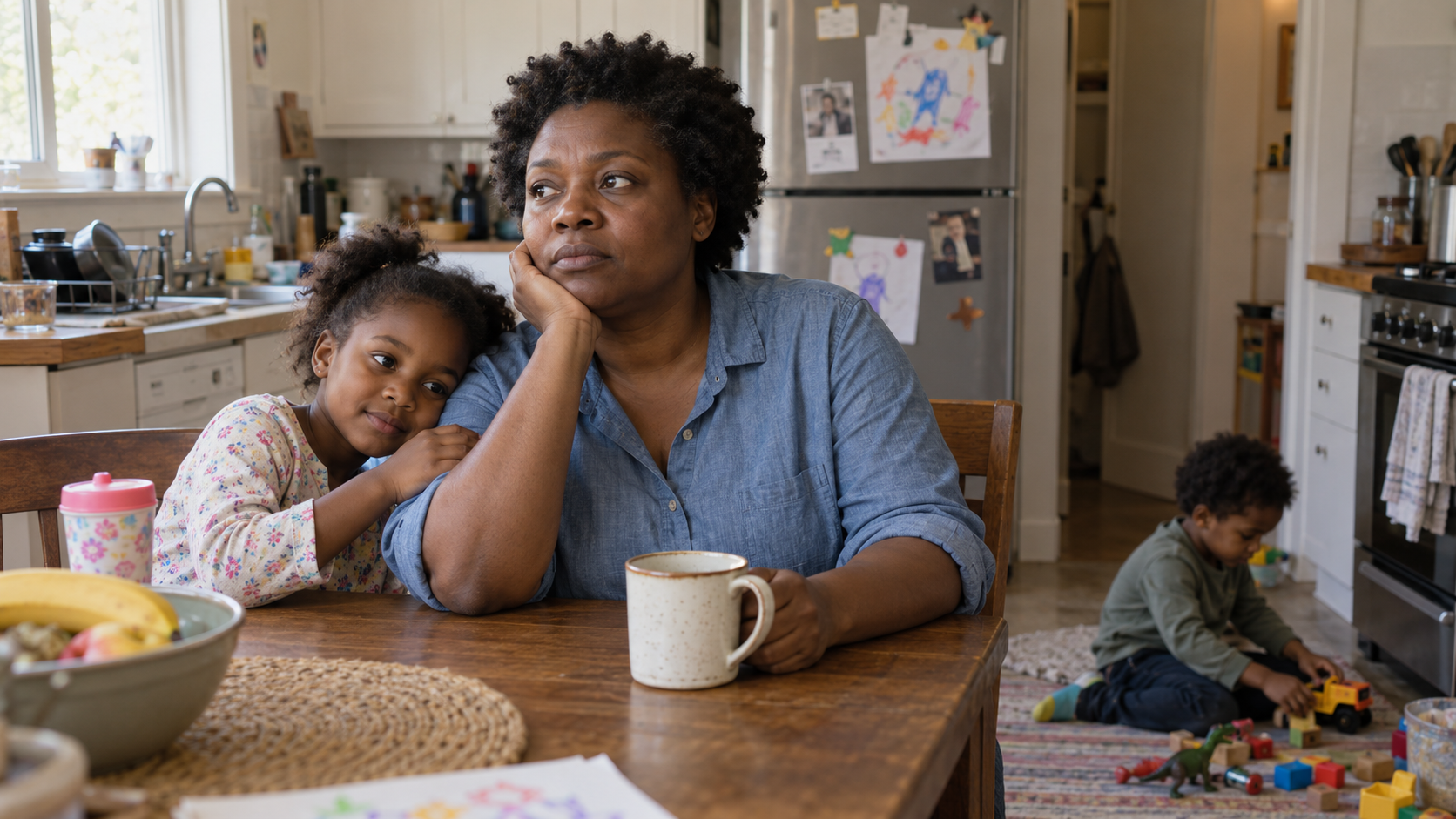
There is a particular kind of loneliness that can come with motherhood.
And the strange thing is, you are almost never alone.
There is someone calling your name, asking where something is, climbing into your bed, needing a feed, a snack, a cuddle, a lift, an answer. Your phone is full of messages. You might speak to other mothers at the school gate or have a partner beside you on the sofa at the end of the day.
Your life can be completely full of people and still feel incredibly lonely.
Because loneliness isn't always about having nobody around you.
Sometimes it is about feeling as though, somewhere in the middle of everybody needing something from you, nobody is really seeing you.
When did everybody stop asking about you?
Motherhood changes the way the world speaks to you.
When you have a baby, people ask how the baby is sleeping. How feeding is going. Whether you've found a routine. Later, the questions change. How are the children? How's school? Are they enjoying their activities?
You answer because these things matter enormously to you too.
But there is a difference between somebody asking about your life and somebody asking about you.
What are you thinking about lately? What do you miss? What are you excited about? What do you want?
Those conversations can become surprisingly rare.
And after a while, perhaps we stop asking ourselves those questions too.
Sometimes you even miss your own brain
There is another part of early motherhood that isn't talked about very much.
Sometimes you miss feeling clever.
You may have gone from having opinions about books, work, films or whatever interested you to discovering that an alarming percentage of your available brainpower is now devoted to somebody else's bowel movements.
You can have an extraordinarily detailed conversation about whether the baby's poo looked slightly greener today, then pick up a book you've been meaning to read and discover you've read the same paragraph four times and still couldn't tell anyone what it said.
It can make you feel a bit stupid, even when somewhere underneath the tiredness you know perfectly well that you haven't suddenly become less intelligent.
Your brain is simply occupied by an extraordinary number of very small things.
And perhaps that's why you can get to the end of a day, completely exhausted, look around and think:
What on earth did I actually do today?
Because there may be very little to show for it.
The washing basket has somehow refilled itself. The kitchen needs tidying again. The baby you spent forty minutes settling has woken up. Nothing feels particularly finished.
But underneath all of that has been an enormous amount of invisible management.
You've been watching the clock without really watching it. Remembering when the baby last fed. Noticing whether they're more tired than usual. Working out whether to let them sleep now or keep them awake a little longer. Mentally calculating when you might next be able to leave the house. Remembering you're running low on nappies while wondering whether that little rash looked worse at the last change.
Meanwhile, you've probably eaten something standing up, answered half a message, started three household jobs and finished approximately one and a half of them because somebody needed you.
So much of mothering isn't a series of completed tasks.
It is constant monitoring, anticipating, remembering and adjusting.
It takes an extraordinary amount of mental space while being almost completely invisible.
Add broken sleep and the fact that most thoughts are interrupted halfway through, and there isn't always much mental space left for Tolstoy.
And you can miss that part of yourself.
You can miss conversations that have absolutely nothing to do with babies. You can miss being interested in something simply because you find it interesting.
You can miss feeling clever.
You can even miss the satisfaction of getting to the end of a day and being able to point to something and say, I did that.
You can know lots of people and still feel lonely
Motherhood changes friendships too.
Some friendships move beautifully with us. Others become harder to hold onto, not because anything dramatic happened, but because life became complicated.
A spontaneous coffee can suddenly require the diary coordination normally associated with an international summit.
Someone's baby gets ill. Someone else's child has swimming. Somebody cancels because nobody slept. You rearrange for Thursday three weeks from now and hope for the best.
And sometimes it isn't the friendship that has changed as much as you have.
The things you want to talk about may be different. The woman you were before children hasn't disappeared, but neither are you exactly her anymore.
You can know plenty of people without necessarily having someone with whom you can say, I don't really know what's happening to me at the moment.
There is a difference between having people around you and feeling known.
Sometimes one person makes all the difference
I don't think this necessarily requires a huge circle of friends.
There is something incredibly powerful about having even one person with whom you can be completely honest.
Someone you don't have to tidy the story up for.
Someone you can tell that you adore your baby and also admit that today felt really long, that you were tired and irritable, or that you found yourself counting the minutes until bedtime.
And someone who will listen while you ponder something so small that you almost feel ridiculous mentioning it.
The strange comment your partner made at breakfast. The fact that the baby slept twenty minutes longer and you're wondering whether it means anything. Something another mother said that has been sitting oddly with you all afternoon. The thing your child did that made you laugh. The completely irrational thought you had at three in the morning.
The minutiae of a life.
Some of it matters. Some of it probably doesn't.
But sometimes you don't know which is which until you've said it out loud.
There is a particular intimacy in having somebody who is interested enough in your inner world to sit with you while you work that out.
Not necessarily to solve it.
Sometimes you just need to say, This happened today and I don't quite know why it bothered me, and follow the thought wherever it goes.
Perhaps that is one of the things we lose when life becomes very busy.
Not simply company, but witness.
Someone who knows the small stories as well as the big ones.
Someone who knows what you've been worrying about, so when you say, Actually, it was better today, you don't have to explain the previous six weeks first.
Someone who remembers what you said you wanted.
Someone with whom you can think out loud.
There is something deeply comforting about being known in that ordinary, detailed way.
Sometimes we don't need another person in the room.
We need one person with whom we don't have to edit ourselves.
You can even feel lonely beside someone you love
This may be the loneliness that is hardest to admit.
You can share a home, children, a bed and years of history with somebody and still feel very far away from them.
Not necessarily because your relationship is broken.
Sometimes two people simply become extremely efficient at running a family.
The person you once stayed up until two in the morning talking to becomes the person you text from upstairs to ask whether they remembered to put the bins out.
Romance.
There are school runs, bills, dinner, bath time, appointments and endless tiny decisions. You can communicate all day without having a conversation that contains either of you.
And then one evening you can look across at someone you love and realise that you miss them.
Perhaps you miss being missed by them too.
Somewhere in all of this, you can become unfamiliar to yourself
We often assume that loneliness means we need more people.
Sometimes we do.
But there is another kind of loneliness in motherhood: becoming slightly unfamiliar to yourself.
You have spent so long noticing what everybody else needs that when somebody asks what you want, you may not have an immediate answer.
Ask what your children love and you could probably give a detailed answer without thinking.
Ask what you want the next few years of your own life to feel like and you may need a moment.
I don't particularly like the idea that motherhood makes women disappear. I don't think we do.
But sometimes there are so many layers of responsibility, noise and other people's needs on top of us that it becomes harder to hear ourselves.
There is a difference.
Maybe the loneliness is worth listening to
We are very quick to treat uncomfortable feelings as things that need fixing.
But sometimes it is more interesting to get curious about them.
Not simply, How do I stop feeling lonely?
But:
What Am I actually missing?
Maybe it's friendship. Maybe it's intimacy. Maybe it's stimulation, laughter or a world that extends a little further beyond family life.
Perhaps you miss work. Perhaps you don't miss work at all, but you miss using a particular part of your brain.
Perhaps you want to learn something. Make something. Go somewhere. Have a conversation that isn't interrupted.
Or perhaps what you miss is the feeling of being deeply known by another person.
There may not be one neat answer.
But there is something valuable about noticing the question.
And what about you?
There are seasons of motherhood when children genuinely need almost everything you have.
A newborn isn't terribly interested in whether you've achieved a satisfying sense of personal balance this week.
Some seasons are simply intense.
But lives change. Babies grow. Children need us differently. And somewhere within all of that, there is still a woman whose inner life matters too.
Not because she needs to become the woman she was before children.
Perhaps that's the wrong direction entirely.
The more interesting question might be:
Who Am I now?
What interests me now?
What do I want more of?
What have I outgrown?
What have I been thinking about quietly for months without really giving it my attention?
Those aren't questions with answers that need to arrive immediately.
Sometimes they begin in very ordinary ways.
A conversation. An old interest. A friend you've been meaning to call. Reading three pages of a book and, eventually, remembering what you've read.
Or simply having somewhere where, for once, you can follow a thought all the way to the end.
That is one of the things I value most about coaching.
Not telling a woman what she should do with her life. Most women have already had quite enough people telling them what they should be doing.
It is having a space where the conversation gets to be about her.
Where the small things are worth talking about as well as the big things. Where a thought can be followed instead of dismissed because it seems insignificant. Where she can wonder out loud, change her mind, contradict herself, laugh at something, get annoyed about something else and gradually notice what keeps coming up.
Because sometimes the things that appear to be minutiae aren't really minutiae at all.
They are the small details through which we begin to understand what is happening in our lives.
And perhaps feeling less alone doesn't always begin with having more people around us.
Sometimes it begins with having somewhere we don't have to edit ourselves.
About Solange
Solange Martins Stanger is the founder of SOL Coaching, a women’s coach, maternity nurse and mother of two, with over 15 years of experience supporting families. She understands how deeply motherhood can change a woman’s sense of herself. Her work offers space for women to feel heard, reconnect with their own needs and explore what they want for their lives—alongside caring for the people they love.